OK, now that we have established some of the parameters, let's try to systematically look at the problem of fakes and how we are trying to help YOU with them. We'll start by category and work our way down. The FIRST category, of course, is the one that is currently 'Rocking' the industry.
The Universal Horror Fakes basically revolve around a VERY High Res scanner and seem to be being produced 3 ways (This does not include the Dracula S2 which is addressed below). They are:
- the primary way is by taking old card stock (mostly lobby) and sanding the front off and attaching a scan of an expensive card. Next, they transferred the blemishes from the old card to the scan. Then they repaired it just like it was a regular card and air brushed over all blemishes.
- the second way, only had a few have been found so far, is similar except they only replaced the center of the card stock, so a review of the edges does not show the layers.
- the last way, which is just now becoming more apparent, involves one sheet and three sheet high res scans being linenbacked so you can't inspect the paper and then airbrushed over the entire poster.
We have a complete report and numerous updates on this since it seems that it is going to be with us for quite a while. 2 major lawsuits really brought this fiasco to the limelight beyond just the industry. You can follow all the events with our updates that we have highlighted on the LAMP home page. We have listed the posters that have been identified in lists by title AND by collector. Here is the link to the Updates which also leads to the original reports in case you haven't been keeping up. We have also TAGGED EACH piece that has been identified in our archive with a 'Controversy Alert' AND placed a sortable tag for pulling a list of reported fakes
~~~~~0~~~~~
These seemed to have come to the surface about 10 years ago, with collectors and dealers giving credit to Dan Rickard and Bob Brooks as first recognizing them. Some try to tie these to the groups of posters that were printed and sold out the back doors of the National Screen Service printing shops as they were closing in the mid 1980s, while others point to groups printing out of Canada and other shops.
This batch is called "Minty Whites" because the back of the posters are a bright white and vary in quality. Some are high quality images and some are not, which gives an indication that they are from more than one source. Some of these may have been around since the 1980s, but some such as the Pirates of the Caribbean International lobby card set, of course, shows that this is NOT entirely correct and there is more than one group (see further down in this section). So, this category looks like it is becomimg a 'catch-all' category for any card stock reproductions that don't appear quite right.
For the past few years, these 'Minty Whites' have been marked in our archive by each reported title with a large sign:
This gives the warning plus a link to more information on that type of fake.
For the sake of analysis, let's separate off the recent rash of lobby card sets into their own batch. Thanks to Bruce Hershenson and Dave Lieberman, we have more information and a list of the reported titles. Click Here
When these and other controversial pieces come to light, we also try to alert you with additional reports and information on that particular poster page in our archive. Here is an example from Star Wars:
We will continue to do so when there are any documented reports or evidence. BUT, we will NOT just go on hearsay. We try to be reporters and not judges when conflicting information arises.
~~~~~0~~~~~
The S2 posters were licensed high grade reproductions that were produced through AFI, but have really come 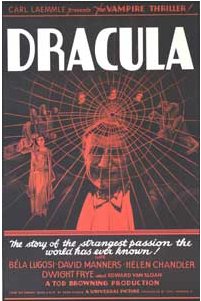 to light and moved into the highly suspicious category because of the recent Dracula one sheet incident. A scam artist glued an S2 version of Dracula (which is the same size) to a board (probably dry mount) so when it was pulled off, it left a gummy fuzzy back to cover markings which caused the need for the poster to be sanded down (covering the thicker paper). They also tore off the identifying marks and had the restorer put in markings like the original (they also messed that up). The old printing style and quality fooled the auction house and authenticating company. Because this was such a rare piece, close scrutiny had many people questioning some of the markings and was eventually found to be fake.
Since that incident, now several other S2 titles have been under close scrutiny with several reports of others but no documentation yet.
We have a complete report on the S2 Art Group. We also have a list of the posters that they issued and identifying marks in the article.
~~~~~0~~~~~
These have not been identified in any attempts YET, but we wanted to alert you that we believe over the next few years that this batch of reproductions are prime material for scammers. In 2007, Hammer authorized British Quad reproductions of their popular horror titles. This was such a popular printing that they are currently up to the 28th title. These are identical size with the only identifying marks on the back and on higher quality paper. Also, because of this poplarity, Hammer then authorized British lobby card SET reproductions. There are currently British lobby card SETS on 30 titles and more coming.
We have an original article on them when they were first released. We also have an update article with a list of the titles for each type. In addition, we have been marking these in our archive with the following statement:
so you can see an alphabetical list of the ones tagged in our archive.. AND in addition to that, we a list of the quads AND a list of the lobby cards sets for you.
~~~~~0~~~~~
Zanart was a commercial company that became popular with a type of foil colored posters. As they grew, they branched into producing commercial lobby card sets for both popular TV series and some classic and popular sci/fi films. These lobby card sets are NOT marked in any way and once the set is broken, is hard to distinguish. Zanart was bought out by a competitor and eliminated several years ago.
We have had complete article and breakdown of all their material on LAMP for 5 or 6 years now but we still hear that there are several dealers that continue to pass these commercial cards off as originals. Here are the articles and lists.
~~~~~0~~~~~
For many, many years individual posters have had fakes reproduced. Their titles have been passed through the industry at various times. Most of these seem to have been by groups during the 1980s. They produced same size reproductions and tried to pass them through the industry, but at that time technology was quite efficient. For example, we have a Blues Brothers one sheet, but the scam artists didn't have a mint copy to make their reproductions from, so my one sheet has a tear.... that isn't there. Numerous Beatles lobby cards were produced with pin holes in the corners that aren't there. One of the tell tale signs of these were the folded lines that are printed but not there on higher gloss ROLLED posters.
Some of these are still running through the hobby. A few years ago, I picked up one at a convention to get signed by a visiting celebrity to see fold lines that weren't there. These smaller operations seem to have died out with technology and a more aggressive type of scammer taking their place with more organized operations.
~~~~~0~~~~~
With the massive amounts of Fakes that are out there, what can be done? Many want to run start vigilante groups and use the internet to bash, judge and lynch whoever is conceived to be the culprit. We TOTALLY disagree with this stance. The days of the Wild West are over. When a culprit is known, the information should be turned over to the appropriate agency to deal with the situation to try to stop them.
After that, we believe that this should be handled just like ANY OTHER plague that hits a society.... RESEARCH AND EDUCATION. Malaria was NOT eliminated by finding the first mosquito that carried the disease and lynching him. A lot of these fakes are now being passed by second and third generation dealers and collectors who do not know that they are fakes. Now that Fakes are mixed in among legitimate posters, research and education are the ONLY plausable way to extract them.
LAMP was built to be a type of repository of information and images. We have THE ONLY CROSS REFERENCED ARCHIVE for movie posters online with approximately 77,000 posters online and cross referenced. We have been marking fakes in the archive for several years now, but due to the recent frantic worry, we have started several more procedures such as tagging to make it easier to get to the information. Here is our newest link for an alphabetically list of posters that fake reports have been filed on.
We will continue to compile and make available pertinent information and reports to try to help dealers and collectors as con artists try to invade and destroy our industry. We ask that anyone that has any documented information about any fakes, contact us and we will be glad to post the information and give credit to the article.